Mostrando entradas con la etiqueta 3D. Mostrar todas las entradas

jueves, 7 de abril de 2022

ROSTI GROUP: YES YOU CAN

Contract manufacturing firm Rosti Group is using Ultimaker 3D Printing Technology to produce fixtures and assembly parts.

The company says it has adopted the Ultimaker S5 Pro Bundle to accelerate product development cycles and help clients get their products to market faster.


By incorporating the Ultimaker S5 Pro Bundle, which is supported by a wide materials range and has the ability to print fibre-reinforced components with the Print core CC, Rosti is replacing traditional prototyping methods where it can to save time, while also additively manufacturing fixtures and assembly components that match the strength and quality of those produced with subtractive methods. 


The results are the supply of new products to consumer markets and product samples to clients within 72 hours: “By removing traditional manufacturing methods from the development of assembly and production fixtures, the Ultimaker S5 Pro Bundle allows us to print high-strength and high-temperature materials at a fraction of the cost of previous methods and completed within a few days instead of weeks,” commented Scott Dickson, NPD Manager of Rosti Suzhou.

“Most certainly, Ultimaker is about fast first-time-right 3D prints of high visual and functional quality, but I get particularly excited when I learn how our technology serves as a transformative business solution for renowned companies like Rosti,” offered Ultimaker CEO Jürgen von Hollen. “The company recognised that it needed a rapid step change to remain competitive. Seeing that the flexibility and sustainable value derived from our 3D Printing Platform and eco-system has a strategic business impact in such a short turnaround time is what drives our teams as well our partners across the world.”

martes, 29 de marzo de 2022

Sillines Personalizados: Vuestro Turno


Durante décadas, los fabricantes de sillines para bicicletas han confiado en la espuma. Sin embargo, después de años de mejora continua la espuma se ha estancado en términos de viabilidad estructural y de diseño.

Las tiendas de bicicletas ofrecen muchas formas, tamaños y tecnologías diferentes, pero hasta la fecha no han sido capaces de ofrecer sillines a medida para uso no profesional, a un coste asequible.

Es verdad que existen sillines adecuados para la mayoría de usuarios, pero también es cierto que ninguno de ellos puede satisfacer plenamente los requisitos personales de cada ciclista, ya que estos difieren no sólo por cada persona sino también por su actividad: no es lo mismo recorrer distancias cortas en áreas urbanas que recorrer largas distancias en carretera, o que realizar ciclismo de montaña: cada ciclista y cada actividad requieren diferentes niveles de rigidez y flexibilidad en el sillín.

Habiendo llevado la espuma del sillín tradicional a sus límites de diseño y rendimiento, ya era hora de que los fabricantes especialistas pensaran de manera innovadora para alcanzar nuevos niveles de comodidad, rendimiento y personalización. Si bien la idea de los sillines de bicicleta impresos en 3D y los prototipos impresos en 3D han existido desde hace algún tiempo, la colaboración entre las empresas atum3D, Forward AM, Hyperganic, e InnovationLab ha dado lugar a una solución que permite crear sillines personalizados de forma única, a escala de producción masiva.

El proceso comienza con un estudio de la estructura ósea del ciclista, mediante el uso de una lámina sensible a la presión: La estructura ósea del ciclista genera un mapa de presión, que indica la distribución precisa de masa y presión aplicada al sillín por el individuo. Basado en el resultado del mapa de presión, el software de Hyperganic permite el diseño de una celosía orgánica tridimensional cuya densidad varía en función de la presión a recibir, para disipar la presión que aplica el ciclista cuando monta en bicicleta. Aprovechando los beneficios de la estructura reticular, este nuevo sillín constituye una gran mejora en la amortiguación y la distribución de la presión, brindando una comodidad sin precedentes para los ciclistas ocasionales y un salto de rendimiento para los ciclistas ambiciosos.


El resultado es una estructura de sillín perfectamente individualizada que distribuye de manera óptima la presión ósea y muscular, maximizando la comodidad del ciclista al minimizar los puntos de máxima presión. A partir de ese resultado se diseña un sillín a medida que se imprime en 3D. Por último, se le aplica un revestimiento resistente pero flexible en una amplia gama de tonos de color personalizados. En cuanto al material de Impresión 3D se utiliza un fotopolímero altamente elástico denominado Ultracur3D® EL 150. Este material de impresión que resulta especialmente indicado para aquellas aplicaciones que requieren elasticidad y flexibilidad, brinda una dureza media y una combinación óptima de alta resistencia y excelente elongación a la rotura. Para dar al sillín un acabado estético se utiliza el material Ultracur3D® Coat F,  robusto pero extremadamente flexible, disponible en una amplia variedad de colores, así como tonos personalizados bajo pedido.


El hardware elegido para esta aplicación precisa es la impresora DLP Station 5-365 EXZ de atum3D: su plataforma de resina abierta permite ajustar la configuración de impresión para que coincida con los requisitos finales del material, minimizando así el desperdicio. Los expertos de atum3D optimizaron digitalmente el diseño de celosía para obtener todos los beneficios del proceso de impresión DLP y las propiedades mecánicas avanzadas de Ultracur3D® EL 150.


miércoles, 23 de marzo de 2022

Additive Manufacturing for 3D Printed Implants: This is a must see

This video highlights the 3D Printed PEEK Implants with Apium M220:

https://www.youtube.com/watch?v=H6e74YOBQAQ

The implants were printed using Apium M220 by Lucid Implants and Skåne University Hospital.

Lucid Implants is an Implant manufacturer based in India. They worked closely with surgeons in multiple hospitals.

Till date they have performed more than twenty surgeries with 3D Printed PEEK Implants.

Skåne University Hospital performed the world's first surgery in which a 3D Printed PEEK Implant is directly manufactured in an hospital.

martes, 22 de marzo de 2022

3DGence Industry F421: Go!!!


Industrial 3D printer manufacturer 3DGence has announced the launch of its latest High-Temperature 3D printing system, the INDUSTRY F421.

The dual-extrusion FFF machine is designed specifically for high-performance applications in sectors such as aerospace, enabling users to print with engineering-grade filaments such as PEEK, PEKK, and ULTEM.

According to 3DGence, the launch is intended to help its customers transition from functional prototyping to full-fledged end-use production. To complement the INDUSTRY F421, the firm has also announced the launch of a new Material Management System and an AS9100-certified PEEK Aero filament.

“At 3DGence, we are supporting our customers across industries in expanding the use of high-temperature and composite materials for end-use applications,” said Ron Faruqui, CEO of 3DGence Americas. “The aerospace industry has the most stringent requirements for material performance due to demanding application environments and critical safety imperatives.”

Based in Poland, 3DGence has been manufacturing high-performance Extrusion-Based 3D Printers since 2014. The firm’s INDUSTRY 3D Printer range has already seen extensive use in sectors such as automotive, aerospace, and medical with over 1000 global installations to date. The new F421 is intended as a successor to the firm’s previous flagship INDUSTRY F420. Much like the newer model, the system is compatible with a plethora of engineering filaments.

For customers on a tighter budget, the company also offers the INDUSTRY F340 and INDUSTRY F350 3D printers. The former is designed for cost-efficient rapid prototyping and provides users with a 260 x 300 x 340 mm build chamber, while the latter features a maximum nozzle temperature of 500°C and a build volume measuring 340 x 340 x 350 mm.

The company’s latest product was designed with productivity in mind. Sporting a large-format 380 x 380 x 420 mm build volume, the INDUSTRY F421 provides ample workspace for both large part and small batch series production. The machine also offers a maximum print speed of 400 mm/s and travel speeds of up to 1 m/s, meaning throughput is a major focus here. Much like the rest of the 3DGence portfolio, the INDUSTRY F421 also boasts an impressive list of material capabilities: With a maximum nozzle temperature of 500°C and an actively heated chamber capable of 180°C, the system can process a wide variety of high-temperature thermoplastics and fiber-reinforced composites. This includes ASA, PC, PEEK, PEKK, and carbon fiber filaments. Specifically, the machine is perfectly suited for the firm’s new PEEK Aero filament. The high-strength polymer combines heat and corrosion resistance for end-use parts in aerospace. Faruqui adds, “Our customers can now rapid prototype and produce proof-of-concept end-parts in PEEK, without doubt of compliance and qualification of the material.”

Of course, when working with engineering materials, it’s also important to consider user safety. The INDUSTRY F421 comes complete with an advanced emissions control system capable of filtering macro dust, nano dust (VOC and UFP), solvent vapor, noxious gases, and other foreign particles. With the help of 3DGence’s new Material Management System, customers also now have a place to store their filaments with the confidence that they’ll be maintained in optimal temperature and humidity conditions. As a cherry on top, the INDUSTRY F421 even has a new three-year warranty policy in select European markets. Sebastian Sczasny, CEO of 3DGence, adds, “With the launch of our new F421, we wanted to make our commitment clear to our users about our quality and service with this new industry standard in warranty. As the market has progressed in requirements and complexity of applications, we designed our printers to meet these enhanced expectations in build quality, component integrity, and ease of use and maintenance.”

(Source: 3D Printing Industry)

sábado, 18 de abril de 2020

The Top-10 3D-Printable Gadgets for Xbox One


Hi gamers! Tired of confinement by the Covid-19? If you have the XBox One and a 3D Printer at hand, here I show you some gadgets for XBox, ready to download and print in 3D.


There are 3 different bottom mounts. A bottom left and right that has side tabs to keep the Xbox from sliding and one without tabs. The bottom wall mounting holes should be 8 1/4" apart for the Xbox One S. This prevents the mounts from blocking any of the air vents.


A standard wall-attachable mount for hanging 2 console controllers. It can be attached to the wall either via 1/16" holes for pushpins or with an adhesive such as Command strips. Designed to be printable on a 7x7" build plate with no supports.


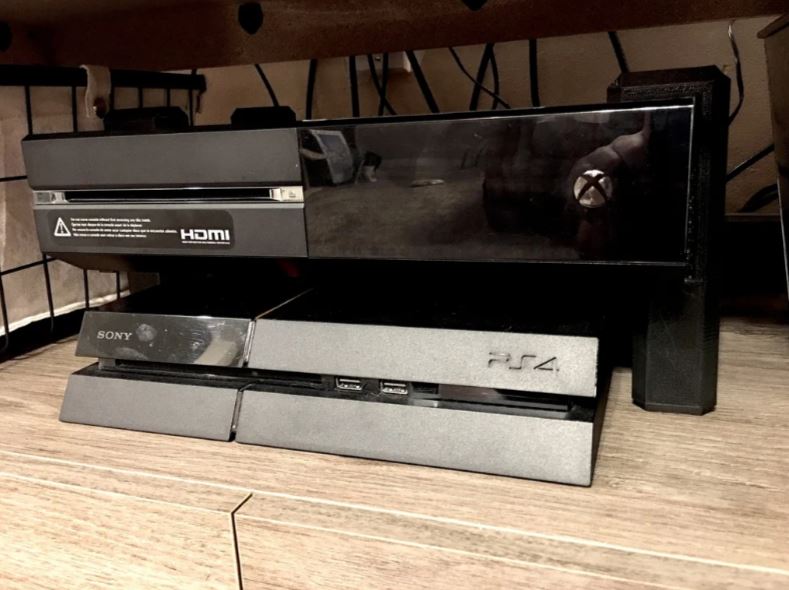
These console risers are intended to lift an original Xbox One safely above a Playstation 4. When your entertainment center is crunched for space, placing the PS4 on top of the Xbox One may seem like the obvious solution... WRONG! Most of the air vents on the Xbox are directly on top and blocking those is begging for you console to overheat. The inverse (Xbox on top of PS4) isn't the most stable of stacking situations. So, the Xbox risers are simple solution to a simple problem.


Rack and pinion steering for your xbox controller. 100 degrees of rotation. Enjoy finer control in racing games.


This is just an Xbox One controller stand but with the Xbox logo.


Xbox controller and headset wall mount


Thumb stick for a standard XBOX ONE controller.


This is a desk holder for the controller clam grips (also works for controllers without the grips).


Current set includes stands for Xbox 360, Xbox One, Gamecube, Nintendo Switch Pro, Steam, and Playstation 4. They're designed to snap to each other, and work in almost all combinations. The Steam controller is the only one that cannot be behind a Gamecube controller due to the unusually large size of the Steam controller. A spacer is included for wired Gamecube controllers, so there's space to place the coiled up cable and rest it besides the controller.


viernes, 17 de abril de 2020

YouMagine: More than you imagine


YouMagine is an online community of 3D Printing Enthusiasts who wish to work together to share, remix and make better 3D Printed Things.

YouMagine facilitates this community, empowers and gives you the tools you need in order to improve, invent & make.

Uniquely YouMagine is primarily a vehicle for supporting open source creation and wants to be a force multiplier for the entire 3D Printing Community. 

Uniquely they are focused on building the entire end to end open source software toolchain to make things malleable.

YouMagine wants CAD & 3D Files to be as easy to create, adapt, share and change as text is nowadays.


jueves, 9 de abril de 2020

¿Could Chinese Cyber Army use 3D Printing to cheat The Pentagon?


“Biometrics are not an Achilles heel,” said Craig Williams, director of Cisco Talos Outreach. “Biometrics are something that makes it very, very easy to use. You don’t have to remember a password. You don’t have to enter a password, which makes it very fast and easy. You don’t have to carry anything around with you. And so I think for most users, it’s still perfectly fine.”

However, it’s possible to use 3D printing technology to create “fake fingerprints” suitable to cheat most fingerprint scanners from Apple, Microsoft and Samsung mobile products: Researchers with Cisco Talos created different threat models that use 3D printing technology, and then tested them on mobile devices (including the iPhone 8 and Samsung S10), laptops (including the Samsung Note 9, Lenovo Yoga and HP Pavilion X360) and smart devices (such as a smart padlock).

The fake fingerprints achieved an 80 percent success rate on average, where the sensors were bypassed at least once. Researchers did not have success in defeating biometrics systems in place on Microsoft Windows 10 devices (though they said that this does not mean they are not necessarily safer; just that this particular approach did not work).


miércoles, 12 de febrero de 2020

Revoluciona la Automoción con HP 3D Printing


HP 3D Printing en colaboración con SERNAUTO ha organizado una serie de seminarios técnicos en Madrid, Barcelona, Valencia y Vigo, bajo el lema “Revoluciona la Automoción con HP 3D Printing”, cuyo objetivo es dar a conocer a fabricantes y proveedores de componentes la nueva tecnología 3D de HP que permite la fabricación digital directa de piezas de uso final, fijaciones y utillajes de montaje, prototipos funcionales, y modelos de concepto.


Importante: Las jornadas van a celebrarse en distintas ciudades españolas, y aunque la  asistencia es gratuita el aforo es limitado; es por ello que debes registrarte para reservar tu plaza. Para cualquier duda, puedes contactar con Laura Prous, Marketing Manager de Integral Innovation Experts, en el teléfono  637 070 666 o mediante el correo-e lprous@integralplm.com


martes, 17 de diciembre de 2019

¿Why Oakley Plans to Prototype Sports Sunglasses Using HP?


3D Printing OEM HP Inc. has just announced that it has expanded and deepened its partnership with Oakley, a leading brand of sportswear sunglasses, to provide 3D Printing Services for designing the brand’s sports performance sunglasses.


HP’s Jet Fusion 3D Printing Platform will be used to develop Oakley products and the process will give Oakley the ability to print prototypes while testing variations of colors and sizes. Oakley has previously used HP’s 3D Printers to create helmet prototypes for sports such as cycling, skiing and snowboarding.


Together, the companies will continue to leverage HP’s Multi Jet Fusion 3D Printing Technology to boost Oakley’s product design process and prototyping: “World-class athletes around the globe depend on Oakley to compete at the highest level, and with HP’s breakthrough 3D printing technology we will not only accelerate our design to production timeline, but we will also reconceptualize the way our products are made, pushing the boundaries of sports performance,” said Nicolas Garfias, head of design at Oakley, in a press release. “Oakley has the highest of design standards, and our innovative 3D printing technology helps them deliver on that experience for millions of athletes around the world,” added Jeff Fawcett, 3D Printing Product Manager at HP Inc. “Together, we are transforming the sports performance community and changing the way the world designs and manufactures consumer products.”


For over 40 years, Oakley has been an important player in the sportswear industry, producing performance eyewear, as well as a range of other products. The company, acquired by eyewear giant Luxottica in 2007, has actually been using 3D Printing since as early as 1992 to streamline its product design process. Actually, Oakley is using HP’s Jet Fusion 580 system to transform and streamline its product design, easily moving from 2D Drawing to physical prototype. With the 3D Printing Technology at their fingertips, Oakley’s designers have the ability to dramatically speed up design iterations, producing prototypes in as little as 24 hours. Moreover, HP’s 3D printing technology enables Oakley to create detailed, full-color prototypes for its eyewear and other products. The company says it can “create rich detailed models by changing the color, breaking up the material in the model and then printing it in different colors to more clearly see different design iterations simultaneously.”


Another advantage of using 3D Printing, according to Oakley, is the ability to test functional parts by replicating the production process and using HP’s 3D High Reusability CB PA 12 material. Finally, Oakley is able to leverage the MJF printer’s build volume to create several prototypes at once.

More info:


martes, 10 de diciembre de 2019

¿Quieres optimizar tus diseños para imprimir en 3D?


Integral 3D Printing Iberia va a impartir una serie de clases magistrales en Fabricación Aditiva que tendrán lugar los próximos 23 y 28 de enero en Bilbao y Madrid, respectivamente.


En estas clases magistrales, los asistentes aprenderán no sólo cómo diseñar y optimizar los diseños para su posterior impresión en 3D, sino que tendrán la oportunidad de conocer, de la mano del propio fabricante, la potente tecnología de HP Multi Jet Fusion aplicada a algunos casos de éxito.


Aprovecha esta oportunidad para aprender de los mejores expertos y conocer en directo las últimas novedades de la tecnología de fabricación aditiva con más potencial en el sector. No dejes pasar esta oportunidad y explota al máximo el rendimiento de la fabricación aditiva en la nueva era de la producción digital gracias a Integral 3D Printing y HP.

Más información e inscripciones:


HP: ¿Alguien que ofrezca más?


HP ha anunciado una serie de soluciones innovadoras para ayudar a los clientes a integrar más fácilmente la tecnología Multi Jet Fusion en sus estrategias de fabricación digital directa; y es que como afirma Ramón Pastor "El camino hacia la fabricación digital requiere mucho más que tecnología. Los clientes demandan soluciones integradas junto con modelos de inversión convenientes que proporcionen previsibilidad, transparencia y flexibilidad para escalar rápidamente sus negocios. Nuestras ofertas reducen las barreras de adopción para que las empresas industriales puedan desplegar más fácilmente las mejores soluciones de impresión en 3D de su clase. Y estos son sólo los primeros pasos: seguiremos colaborando con clientes y socios para ser pioneros en la creación de nuevos modelos que desbloqueen y aceleren el poder de la fabricación digital".


Para ayudar a aquellos clientes que están escalando hacia la fabricación digital directa en masa mediante Impresión 3D, HP ha lanzado una variada gama de nuevas opciones para ayudarles, basadas en el acrónimo 3DaaS o 3D as a Service: Un nuevo servicio de HP basado en el modelo "pay per build" o pago por fabricación, que proporciona a los clientes una reposición automática de los consumibles HP 3D, un seguimiento sencillo de la facturación y el uso, así como servicios de asistencia técnica fiables in situ y a distancia. Una nueva oferta pensada para los clientes que buscan una solución única para todo el ciclo de vida del producto: Desde acelerar los desarrollos acortando los tiempos de obtención de prototipos, hasta la fabricación digital directa de piezas para uso final.


Por otro lado y pensando en aquellos clientes cuyas necesidades no requieren tanto el contar con una máquina de uso interno como contar con proveedores de servicios para casos puntuales, HP está ampliando su red de fabricación digital HP Digital Manufacturing Network con nuevos socios: Prototal en Europa y Solize en Japón. La HP Digital Manufacturing Network es una comunidad global de proveedores de servicios de fabricación digital directa con una capacidad probada para la producción de piezas de alta calidad y alto volumen, ya sea mediante la tecnología HP Multi Jet Fusion o mediante la tecnología HP Metal Jet. De esta manera, más clientes de todo el mundo podrán acceder a estas tecnologías para obtener piezas de plástico o de metal, cuando y donde lo necesiten.


En cuanto a nuevos materiales, Lubrizol ha presentado un nuevo material de poliuretano termoplástico (TPU) denominado ESTANE® 3D TPU M95-A, certificado para las soluciones de impresión 3D HP Jet Fusion 4200. El TPU es ideal para fabricar piezas flexibles y elásticas y abre nuevas oportunidades de mercado para clientes actuales y futuros de HP: No en vano "HP está proporcionando mucho más que una impresora 3D, han proporcionado una solución completa para la producción de piezas finales en volumen", afirma Doug Collins, fundador y copropietario de Avid Product Development. "Nuestra capacidad para utilizar el hardware, los datos, el software y los servicios para mejorar todos los aspectos de nuestra productividad y eficiencia operativa, junto con las características innovadoras y los nuevos materiales como el TPU, han aportado un gran valor a Avid y a nuestros clientes".

viernes, 6 de diciembre de 2019

¿Why Volkswagen continues to produce 3D printed parts with HP Metal Jet?


In September 2018, the American manufacturer HP announced the arrival of its metal 3D Printer, the HP Metal Jet.


Among the first users of the technology is the car manufacturer Volkswagen. For the past year, the German company has been testing the machine’s capabilities and does not seem to be disappointed since it has 3D printed about 10.000 parts in just a few weeks.


For the launch of its new electric vehicle ID.3, Volkswagen made miniatures of the car in metal, through a partnership with GKN Powder Metallurgy. Measuring 2.5 cm long, the 3D printed parts, which serve a marketing function, represent a successful first step in Volkswagen’s roadmap to achieve 3D printing of structural parts for its cars by 2021.


Volkswagen now has 90 3D printers installed in its factories, including HP Metal Jet printers. These were first used to create custom aesthetic parts such as custom keys, etc. The second phase will focus on the production of functional parts such as gearshift knobs and mirror mounts. Volkswagen’s goal is to print 50.000 to 100.000 functional parts the size of a football per year.


Dr. Martin Goede, Head of Technology Planning and Development at Volkswagen, said: “Our vision of industrializing additive manufacturing is quickly becoming a reality with HP Metal Jet, changing the game for the automotive sector. The pace of HP’s innovations and the advanced capabilities of the technology have exceeded our expectations. We achieve our objectives and actively identify and develop functional components for production.”


The car manufacturer’s strategy is therefore progressing according to its plans: the production of the 10.000 miniatures of the new car is proof of this. It took only a few weeks to manufacture this impressive series at HP’s and at its partner, GKN Powder Metallurgy’s plant in Barcelona. The small cars were distributed to Volkswagen employees and dealers around the world. Dr. Goede adds: “What better way to showcase innovation at Volkswagen than to use our own technologies in the marketing campaign for the first ID.3 launch. We are extremely satisfied with the technical specifications, speed, quality and low cost per part provided by HP Metal Jet. The surface quality and resolution allowed for great attention to detail and added a special touch to this important milestone for the company.”

jueves, 25 de julio de 2019

Los diez mejores sitios para encontrar ficheros 3D


Vamos a ver en este post una selección de los mejores repositorios de ficheros 3D, especialmente útiles para todo aquel que necesite imprimir un objeto y no tenga conocimientos ni herramientas de diseño en 3D. Algunos de estos repositorios también permiten compartir e incluso vender diseños 3D. Por lo tanto, si modelas en 3D y deseas darte a conocer e incluso ganar algo de dinero extra, pueden ser plataformas perfectas para mostrar tu trabajo.

Thingiverse
El mayor repositorio de modelos 3D en Internet es Thingiverse: el sitio ofrece cerca de 2 millones de archivos STL, dejando a la competencia muy atrás. El sitio web está gestionado por MakerBot, y permite compartir modelos 3D etiquetados en colecciones personales.


CGTrader
Mercado online para comprar y vender diseños 3D. Sin embargo, también ofrece una selección de archivos gratuitos para descargar. De su más de 740.000 modelos, un gran número se puede imprimir en 3D.


MyMiniFactory
Es un espacio comunitario y un repositorio con más de 50.000 archivos, pero más orientado a juegos y cultura geek. El sitio ofrece archivos 3D hechos por diseñadores profesionales, y alberga una extensa colección de archivos STL gratuitos de patrimonio cultural.

Cults
Con sede en Francia, Cults es una comunidad y un mercado para compartir o vender ficheros STL. El estándar de sus más de 40.000 modelos es generalmente alto, y los usuarios pueden seguir a sus diseñadores favoritos u obtener actualizaciones instantáneas cuando se publica una nueva creación. También ofrece colecciones basadas en marcas populares de renombre (GoPro, Ikea, Lego, etc.)


Pinshape
Sitio web de excelente apariencia que se describe a sí mismo como un "mercado 3D lleno de diseños de alta calidad". Esto significa que puedes encontrar un montón de archivos STL gratuitos para descargar, pero también funciona como una plataforma para comprar y vender modelos 3D premium. Este es el lugar si buscas archivos STL de aparatos, arte, electrodomésticos, juegos, juguetes y miniaturas.


TurboSquid
Ofrece una gran cantidad de modelos 3D gratuitos y premium. Orientado más hacia AR y VR que a la impresión 3D.


3DExport
Dirigido a diseñadores profesionales, 3DExport es un mercado para modelos de de primera calidad. Además de los modelos 3D genéricos y low-poly, 3DExport ofrece una selección de más de 10.000 diseños imprimibles en 3D. También puedes filtrar tu búsqueda para encontrar una pequeña colección de archivos STL gratuitos para impresión 3D, con énfasis en joyas y adornos.


NIH 3D Print Exchange
Un recurso fantástico para la comunidad de Ciencia, Tecnología, Ingeniería y Matemáticas (STEM, por sus siglas en inglés); una plataforma para compartir, distribuir y descargar archivos de impresora 3D que sean científicamente exactos o médicamente aplicables. Las colecciones incluyen aproximadamente 7.000 archivos STL gratuitos para prótesis, neurociencia, una "biblioteca del corazón" y una "molécula del mes".


NASA
Un repositorio muy emocionante de modelos 3D creados por la NASA. Los archivos STL están disponibles de forma gratuita con fines educativos.


Yeggi
Motor de búsqueda que rastrea muchos sitios web de impresión 3D para encontrar modelos 3D. La interfaz de usuario no ganará premios a corto plazo, pero es una herramienta eficaz para encontrar archivos STL gratuitos.